
Cyber Protection Basics Every Business Owner Should Understand
Key Takeaways
- Cyber protection is an ongoing plan, not a one-time IT purchase; it covers what happens before, during, and after an attack.
- Backups only protect you if they’re tested, encrypted, and separated from your main network so ransomware can’t reach them.
- Business continuity planning keeps you serving customers during an outage, even while systems are still being restored.
- Treasure Coast businesses face storm season and cyber risk at the same time, so recovery plans need to account for both.
If you run a business in Stuart or anywhere along the Treasure Coast, you’ve probably heard plenty about firewalls, antivirus software, and employee training. Those defenses matter, and they belong in any serious cyber protection plan. But prevention is only half the story.
At C&W Technologies, we’ve spent more than 40 years helping local businesses plan for the moment a threat actually gets through, because for most businesses, sooner or later, one will. Real cyber protection isn’t just about stopping attacks. It’s about what happens next: how fast you recover your data, how quickly you get back to serving customers, and whether your business survives the disruption at all.
This guide walks through the part of cyber protection that often gets skipped: backup recovery, business continuity, and incident response.
What Does Cyber Protection Really Mean for a Small Business?
Cyber protection is often treated like a single purchase: install antivirus software, set up a firewall, and consider it done. In reality, it’s a layered plan covering prevention, detection, response, and recovery.
Tools like email filtering and endpoint security reduce how often a threat reaches you in the first place. But no defense blocks everything, forever. The businesses that recover fastest from an incident are the ones that also planned for what happens after prevention fails: working backups, a documented response process, and a way to keep operating while systems come back online.
Why Do So Many Businesses Never Recover After a Cyberattack?
Speed matters more than most owners realize. According to IBM’s Report, it takes organizations an average of 241 days to identify and contain a breach, which is actually the fastest response time in nine years. Even at its best, that’s nearly eight months of exposure.
Every additional day a breach goes unresolved adds cost: lost revenue, lost productivity, and lost customer trust. FEMA’s own business preparedness research shows how damaging a slow recovery can be: 40% of small businesses affected by a major disruption never reopen, and another 25% close within a year.
The businesses that make it through share one thing in common: a documented plan for backup, recovery, and communication, built before the incident happens, not scrambled together during one.
How Does Backup and Recovery Fit Into a Cyber Protection Plan?
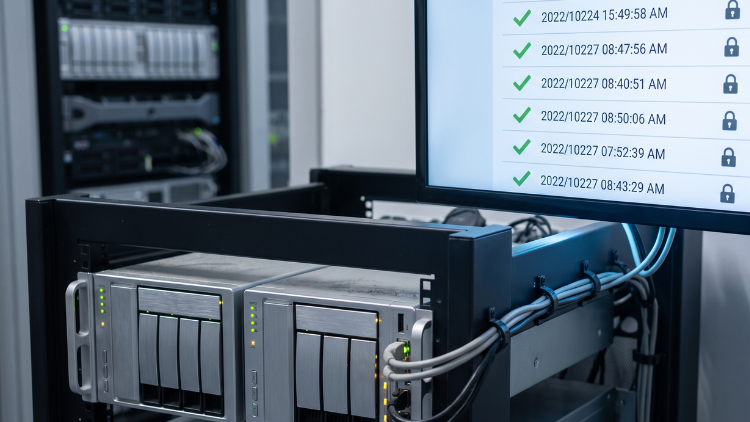
Backups are the foundation of recovery, but not every backup protects you the same way. Ransomware increasingly targets the backups themselves.
That’s why an effective backup strategy includes a few specific things:
- Encrypted, offsite (or cloud) storage kept separate from your main network
- Versioned backups so you can roll back to a clean point before the attack occurred
- Regular, tested restores, not just backups that run automatically and are never verified
C&W’s cloud backup and disaster recovery services build these protections in from the start, so a backup is something you can actually count on, not just something that shows a green checkmark.
When Should a Business Update Its Incident Response Plan?
An incident response plan isn’t something you write once and file away. It should be revisited whenever your business changes: new software, a new location, new staff with system access, or after any close call that didn’t turn into a full incident.
Storm season is a good example for businesses on the Treasure Coast. Storms bring power outages and physical disruption on top of the usual cyber risk, so a continuity plan needs to account for both at the same time. If your plan hasn’t been tested in the past year, or your team isn’t clear on who does what during an outage, that’s a sign it’s time for a review.
Building a Business Continuity Plan That Holds Up Under Pressure
A business continuity plan answers one core question: how do you keep serving customers while systems are down? That question matters because downtime is expensive.
A workable continuity plan generally includes:
- Clear recovery time and recovery point objectives for your most critical systems
- A communication plan for staff, customers, and vendors during an outage
- A defined chain of responsibility, so no one is guessing who has the authority to switch operations over to backups
This isn’t a document you write for compliance and set aside. It’s a plan you walk through with your IT partner and revisit as your business grows.
What Strong Incident Response Looks Like in Practice
When a threat does get through, the first hour matters most. Most effective incident response plans follow a similar general pattern: containment (isolating affected systems so the threat can’t spread further), investigation (understanding what happened and what was touched), recovery (restoring clean data from tested backups), and review (updating the plan based on what was learned).
Businesses that have practiced this process ahead of time recover faster and with far less guesswork than those improvising in the moment. That difference is often what separates a bad day from a business-ending event.
Why Local Expertise Matters for Cyber Protection on the Treasure Coast
Cyber protection isn’t one-size-fits-all. A medical office in Stuart has different compliance obligations than a CPA firm in Port St. Lucie or a construction company in Martin County; each needs a recovery and continuity plan built around its own regulatory and operational realities.
C&W Technologies has worked with businesses across the Treasure Coast since 1985, which means we understand the specific risks, industry requirements, and seasonal challenges, storms included, that come with operating here.
As a managed IT partner, we build cybersecurity, backup, and continuity planning into one ongoing relationship rather than treating them as separate, one-off projects. That’s what allows a business to keep running when an attack, an outage, or a storm gets through the front door.
Final Takeaway
Cyber protection was never about eliminating every possible risk; no business can promise that. It’s about making sure that when a threat does get through, your data is recoverable, your team knows what to do, and your business keeps running. Prevention buys you time. Backup, continuity, and incident response are what actually get you back on your feet.
Ready to Close the Gaps in Your Plan?
For more than 40 years, C&W Technologies has helped businesses across Stuart and the Treasure Coast build technology they can rely on, not just when everything is working, but especially when it isn’t. If it’s been a while since you’ve reviewed your backup, continuity, or incident response plan, we’re happy to take a look and show you where the gaps are. Schedule a consultation with our team to see how a managed IT partner keeps your business running when it matters most.